1. The Internal Baseline
Overnight Heart Rate Variability (RMSSD), resting heart rate, and sleep architecture measured against your personal 28-day rolling median, never generic population charts.

A heart rate of 150 bpm in a laboratory is physiologically distinct from 150 bpm at 1,800 metres altitude in 32°C heat. SWEL eliminates the context gap between sensors and human biology.
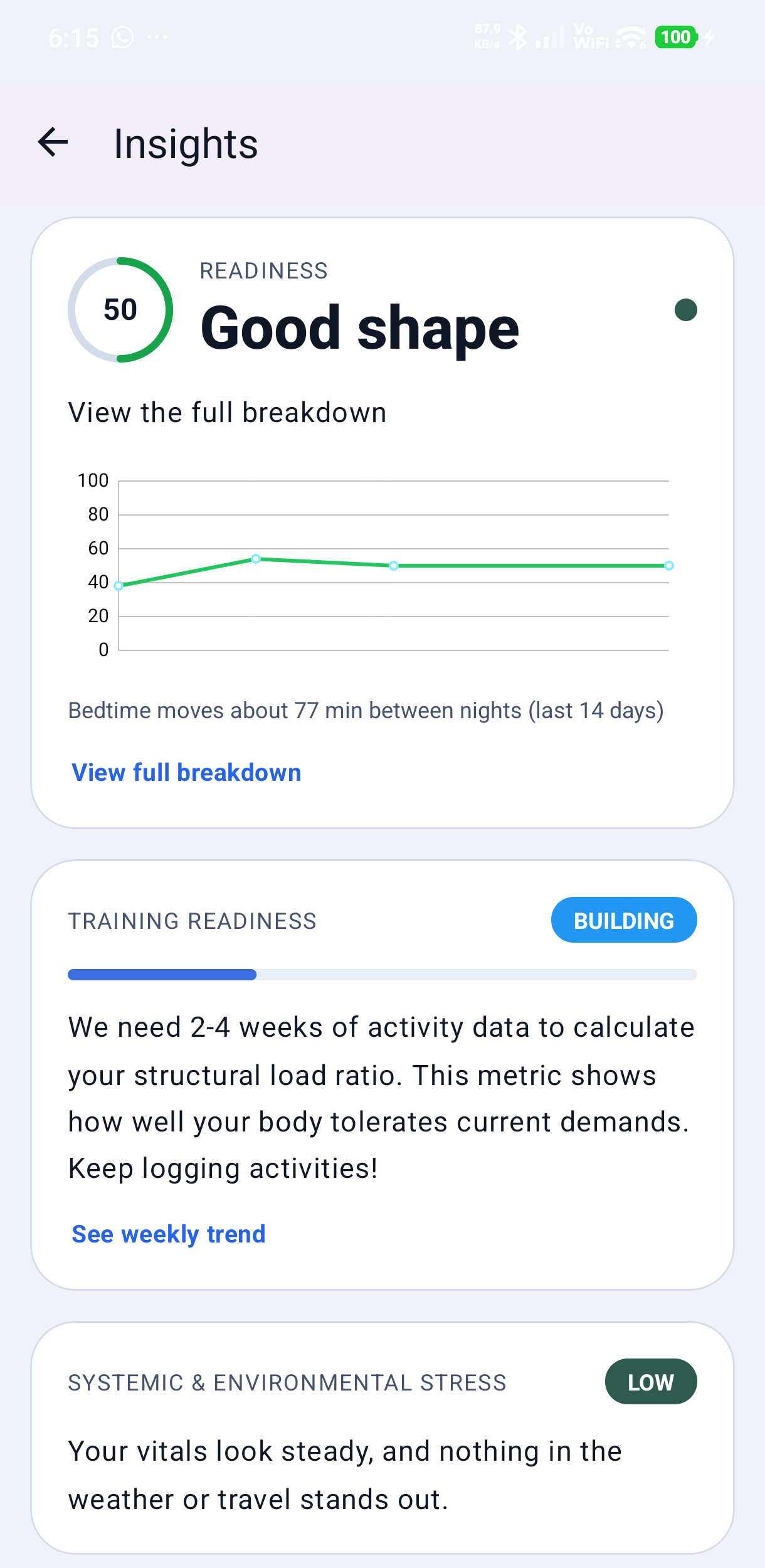
SWEL continuously synthesizes internal physiological baselines, acute training load, and environmental multipliers to compute systemic strain.
Overnight Heart Rate Variability (RMSSD), resting heart rate, and sleep architecture measured against your personal 28-day rolling median, never generic population charts.
Calculates cumulative systemic fatigue utilizing Banister TRIMP and session RPE over 7-day and 28-day horizons to instantly identify dangerous workload spikes.
Persisted climate telemetry, ambient heat, barometric pressure, wind resistance, UV, and marine swell, quantifying external stress imposed on human energy systems.
An athlete in a locker room and a clinical biokineticist reviewing cardiac stress demand different depths of presentation. SWEL delivers both seamlessly in a single toggle.
Recovery, load and what to do today.
Deviation from your baseline, LOINC tags, acute to chronic load ratio.
Generic fitness apps flag abnormalities based on rigid population averages. If your natural resting heart rate is 42 bpm, sitting at 52 bpm is a major anomaly, yet a standard app marks it as optimal.
SWEL builds a personalized normal curve from 28 continuous days of sleep and resting biometrics. When a multi-day upward drift occurs, SWEL flags systemic autonomic strain before overt symptoms or injuries emerge.
Educational & Performance Guidance · Non-Diagnostic
Resting heart rate and overnight vitals build your personal normal.
A multi-day climb outside the envelope raises a gentle early warning.